


Table of Contents
Covering up a hand tattoo is a bold move, mainly because the hands are high-visibility “prime real estate” and the skin there is notoriously tricky to work with. Since you’re dealing with thinner skin and constant movement, a successful cover-up requires a strategic approach.
Here is a breakdown of how to turn that old ink into something you actually want to show off.
1. The Strategy: Bold and Dark
Because hand tattoos are often subject to “fading” and “spreading” over time, a cover-up needs to be dense. You can’t usually cover black ink with light shading or fine lines.
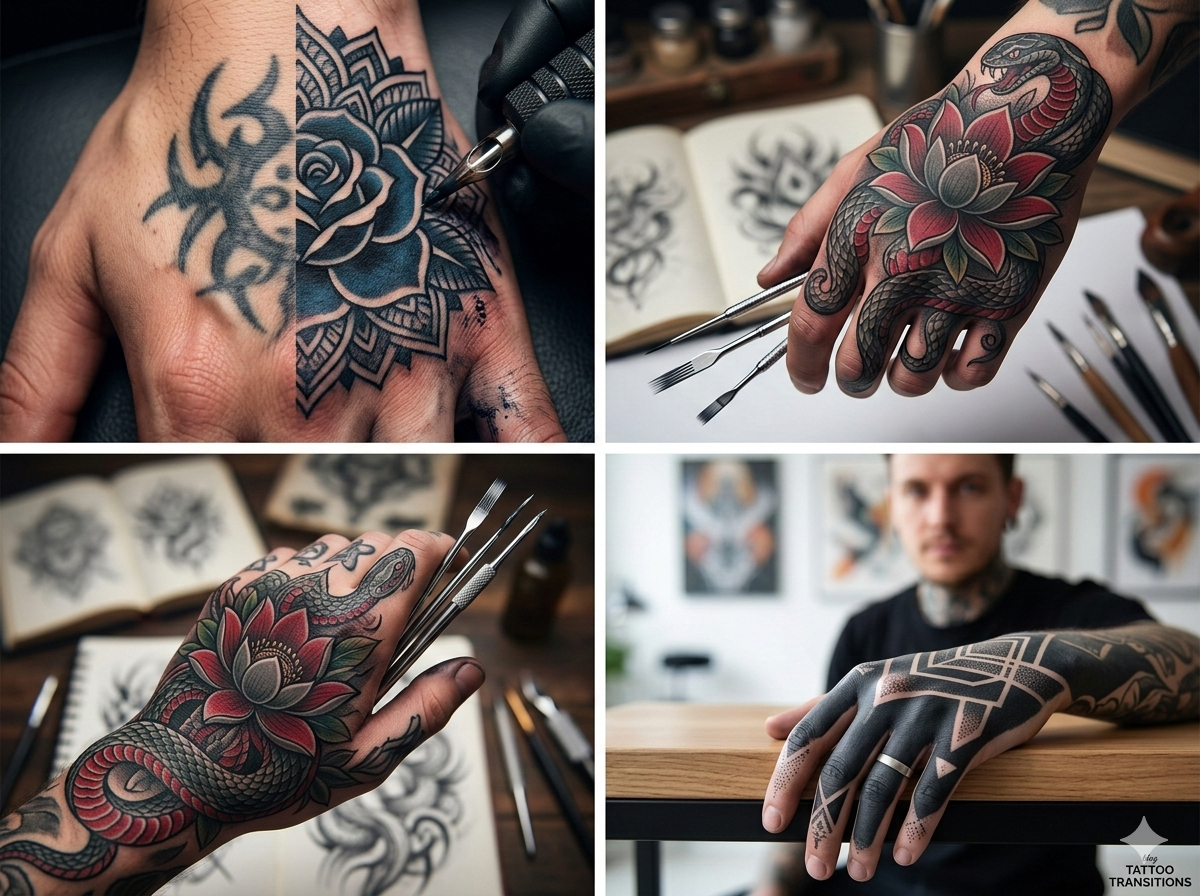
- Traditional/Neo-Traditional Styles: These are king for hand cover-ups. Think bold black outlines and saturated colors (deep reds, blues, or greens).
- Bio-Organic/Mechanical: These styles use complex textures and shadows that can easily “hide” the old lines within new patterns.
- Mandala or Geometric: Great for using heavy blackwork to mask old shapes, provided the symmetry aligns well with your hand’s anatomy.
2. Common Design Ideas
- The “Job Stopper” Classic: A large, detailed rose. The petals provide perfect overlapping layers to mask underlying ink.
- Traditional Eagle or Owl: The feathers create natural “noise” that distracts the eye from what’s underneath.
- Blackwork/Sclera: If the old tattoo is very dark, a heavy ornamental blackwork design can turn the entire area into a solid, intentional piece of art.
3. Reality Check: The Challenges
Before you sit in the chair, keep these factors in mind:
- Size Increase: To effectively hide an old tattoo, the new one will almost always be 20-30% larger than the original.
- The “Blowout” Risk: Hand skin is thin. If your artist isn’t experienced with hands, the ink can blur. Choose an artist who specifically highlights hand tattoos in their portfolio.
- Fading: Hands heal differently because we use them constantly. Expect to need at least one “touch-up” session after the initial cover-up heals.
4. Pro-Tip: Lighten it First?
If your current tattoo is very dark or has heavy scarring, many artists will recommend 1 or 2 sessions of laser removal first. You don’t need to remove it completely, just fading it to a “ghostly” grey makes the artist’s job much easier and gives you more design options.
5. How to get started
To give you more specific advice, I’d need a bit more detail:
- What is the current tattoo? (Is it a small symbol, a name, or a full-hand piece?)
- How dark is it? (Faded grey or solid jet black?)
- What’s your vibe? (Dark and edgy, floral and soft, or heavy traditional?)
>> Read more: 4 Things to Know Before Your Neck Tattoo Cover Up
The hangout tattoo studio – Traditional tattoo style by us.
- Adress: 25 An Thượng 4, Đà Nẵng City – Tel: +84348040194 – https://thehangouttattoo.com/danang/
- Adress 302 Cửa Đại, Hội An Ancient town – Tel: +8498855302 – https://thehangouttattoo.com/hoian/

 Tiếng Việt